
1. A Scene
You're at a Chinese restaurant. You pick up one chopstick and try to pick up food. Nothing works — the food spins around the plate, refusing to come up. You feel frustrated, then look up at the person next to you and realize they have two chopsticks. Two. Not one.
You suddenly think: Oh, right. You're supposed to use both of them.
2. A Funny Misunderstanding
Some Europeans have hilarious first moments with chopsticks: holding only one stick like a pencil, or separating the two sticks and holding each one like a conductor's baton, poking around the plate.
One person even wondered: "Why not three? Wouldn't three be more stable?"
3. The Chinese Explanation
One chopstick cannot pick up food. This is the simplest physical fact, but the Chinese saw a profound philosophy in it:
Alone, one is easily broken. Together, many are hard to destroy.
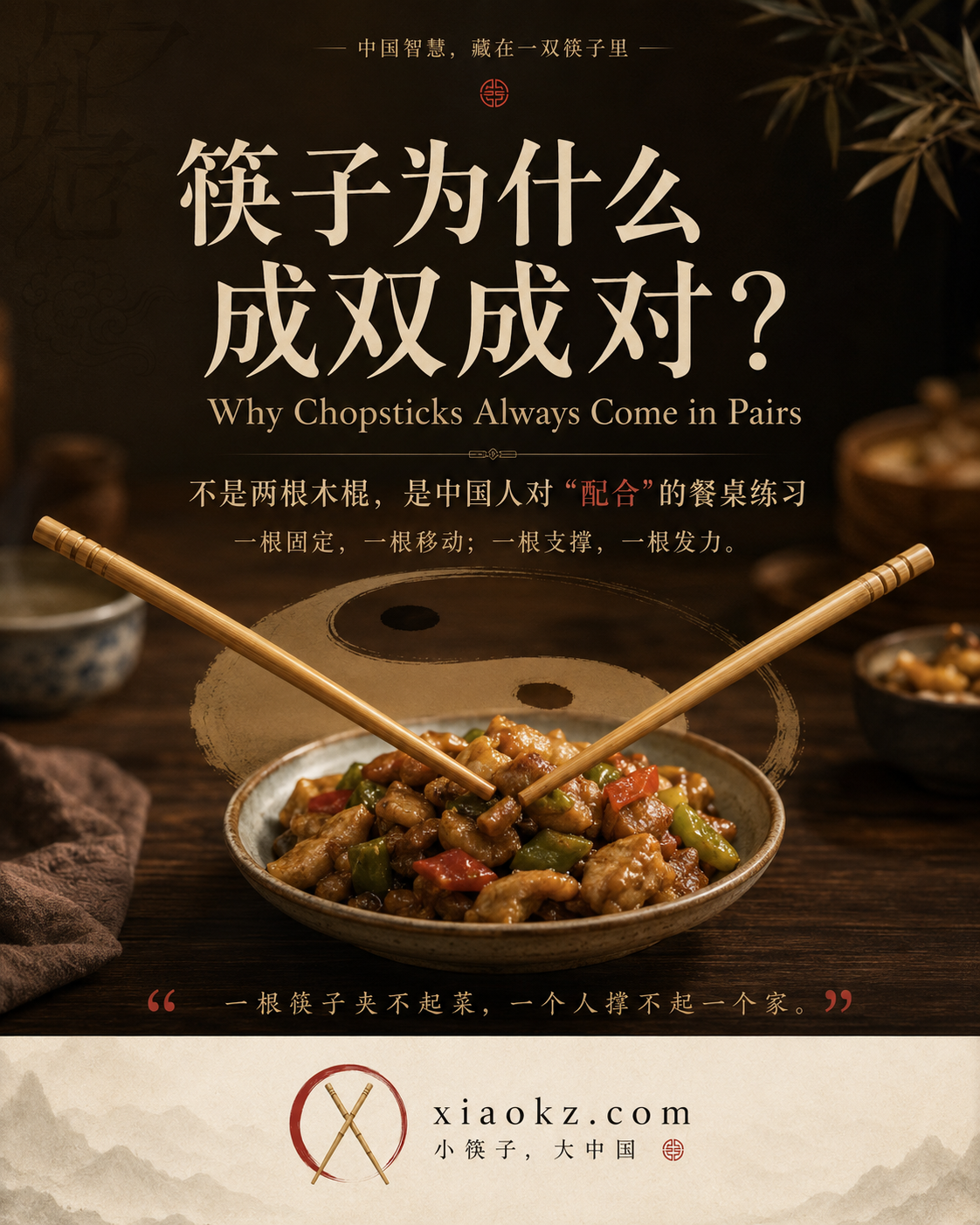
Two chopsticks must work together: one holds, one moves; one supports, one applies force. They cannot act independently, nor can one replace the other. They must cooperate, and the way they cooperate must be just right — too loose and the food slips, too tight and the food is crushed.
This "just right," the Chinese call it harmony (和, hé).
4. The Deeper Logic
Chinese culture has a core concept called yin and yang (阴阳, yīnyáng) — yin and yang are not opposites, but complementary. Like chopsticks, one still and one moving, one leading and one supporting, they must work together to accomplish something.
This is quite different from Western individualism. The West emphasizes "a good tool should be able to work independently" — so a fork has tines and a blade, and one person can handle it alone. But Chinese philosophy says: "The best state is not one person being very strong, but two people working together seamlessly."
Chopsticks come in pairs because the Chinese believe: nothing important is ever done by one person alone. Family, team, society — they are all enlarged versions of "a pair of chopsticks."
5. Learn a Chinese Word
配合 (pèihé)
- 配 (pèi): to match, to pair
- 合 (hé): to combine, to fit together
- To cooperate is not to obey. It means each person does their own part well, so the whole system works. When a Chinese person says "you two cooperate well," it is one of the highest compliments.
- Remember: in Chinese, "配合" emphasizes默契 and complementarity more than "合作" (cooperation).
6. One-Sentence Summary
> One chopstick cannot pick up food. One person cannot hold up a family. The Chinese learned at the dinner table: the most important things are always done by two people together.