1. A Scene
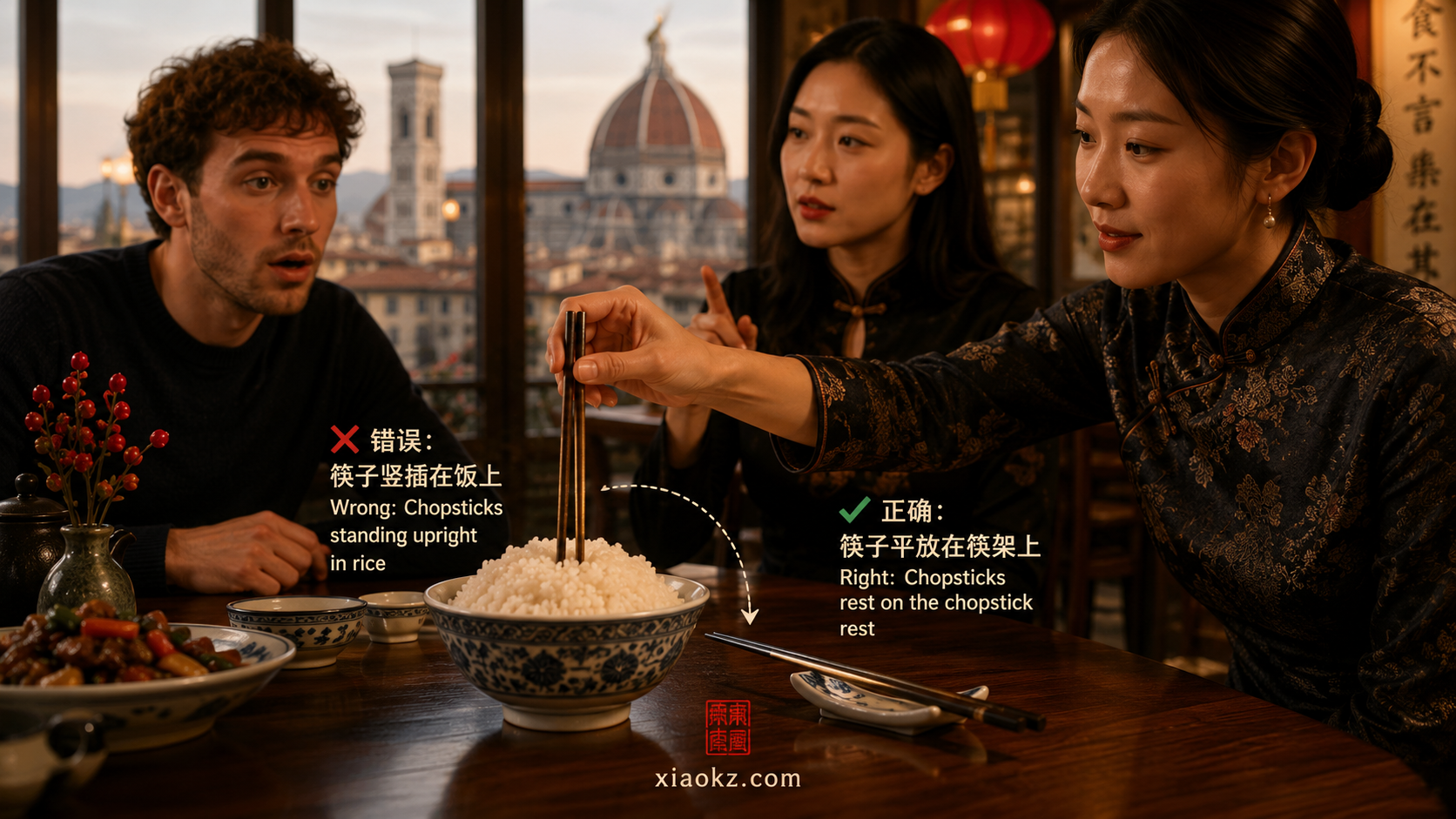
You finish a bowl of rice, feel satisfied, and without thinking, stick your chopsticks upright into the remaining rice — like sticking a fork into a piece of bread at a European restaurant, or standing a knife in a baked potato. It seems convenient: the chopsticks won't fall over, won't roll onto the table, won't get the tablecloth dirty. It's practical, it's tidy, and it keeps them within easy reach for the next round of rice.
Suddenly, your Chinese friend's face changes. The color drains from his cheeks. He quickly, almost frantically, pulls the chopsticks out of the rice, lays them flat on the chopstick rest, and looks at you with a serious but controlled expression, as if trying to manage a crisis without alarming the other guests. "Please," he says, his voice lower than usual. "Please don't stick chopsticks in the rice."
"Why?" you ask, genuinely confused. "It was just convenient. I didn't want them to roll off the table."
"Because," he says, choosing his words carefully, "it looks exactly like burning incense for the dead."
The table goes quiet. You look around. Everyone is avoiding eye contact. You have just, unknowingly, performed a funeral ritual in the middle of dinner.
2. A Funny Misunderstanding
Many foreigners have this exact reaction the first time they hear this explanation: "Wait, what? Sticking chopsticks in rice is like burning incense for the dead? How does that even work? They're just chopsticks! And it's just rice!"
A Spanish friend once joked, trying to find a loophole: "So if I stick them in mashed potatoes, does that count? Potatoes aren't rice, so technically it should be fine, right? What about polenta?"
Another European said: "In Italy, standing candles upright in a round loaf of bread is a rustic centerpiece for Christmas dinner. In China, standing chopsticks in rice is a funeral. Culture is wild. One country's decoration is another country's desecration."
An American friend told me: "I thought I was being polite by keeping my chopsticks neat and tidy. Turns out I was being politely horrifying."
3. The Chinese Explanation
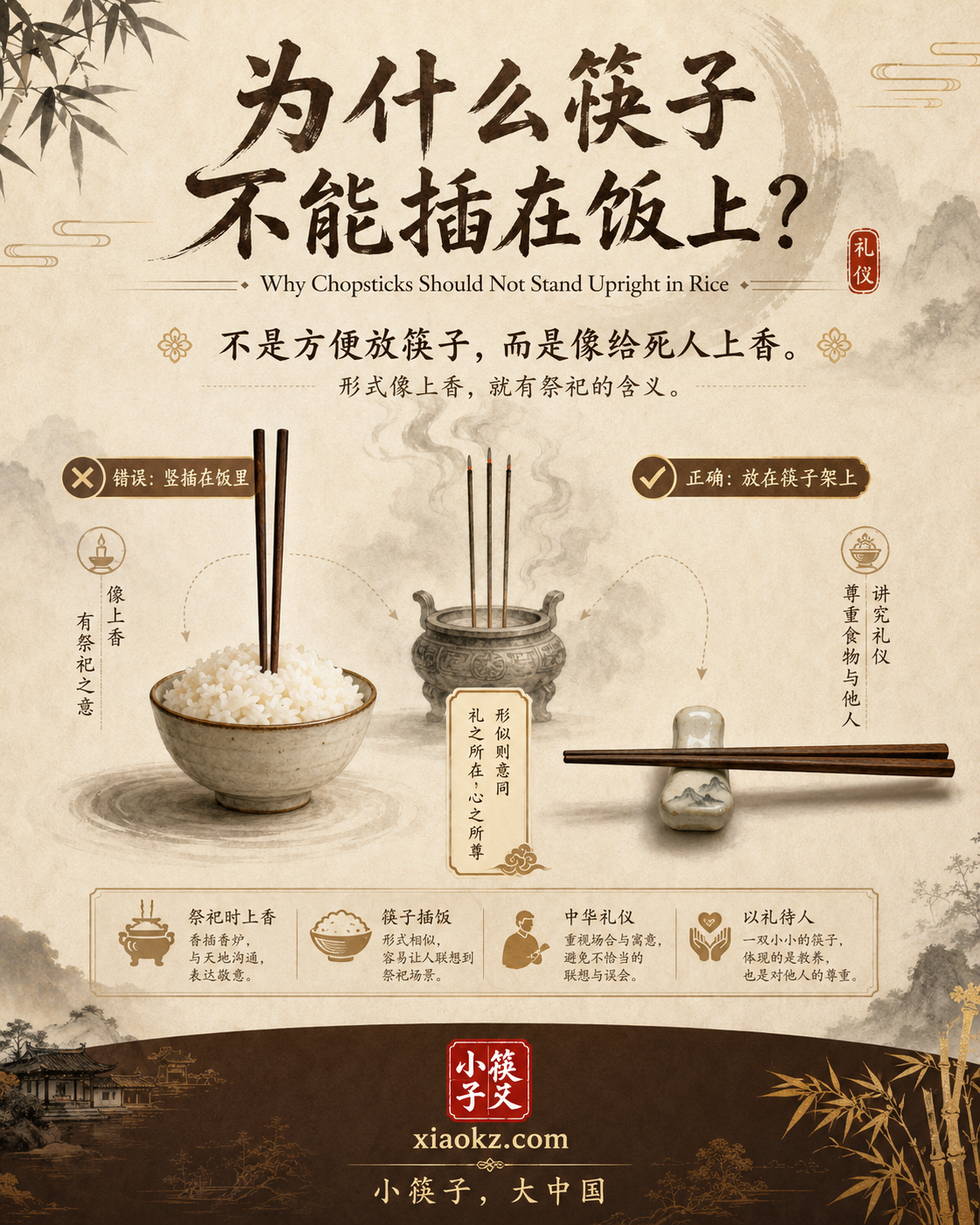
The origin of this taboo is very specific and visually unmistakable: in traditional Chinese funeral rituals, people burn incense for ancestors or the deceased. The incense sticks are placed vertically in an incense burner or a bowl of rice offered as a sacred vessel. They are thin, straight, and usually come in twos or threes — the visual shape, the vertical placement, the pairing of sticks is almost identical to chopsticks stuck upright in a bowl of rice.
So when you stick chopsticks vertically into rice at the dinner table, the Chinese person is not seeing "a convenient way to rest chopsticks." They are seeing "a funeral ritual performed on a bowl of food." They are seeing incense for the dead. They are seeing an offering to ancestors. They are seeing the table transformed into an altar, and the meal transformed into a memorial.
The image is so culturally loaded, so visually precise, that it triggers an immediate, visceral reaction before conscious thought can process what is happening. It is a matter of visual identity: two sticks standing in rice equals funeral. Period.
4. The Deeper Logic
This taboo reflects the Chinese attitude toward death and ancestors — an attitude that is deeply embedded in daily life, not reserved for special occasions. Chinese ancestor veneration is not an annual ceremony; it is a continuous, everyday presence. The visual symbols of honoring the dead are everywhere in Chinese culture: on home altars, in temple offerings, in cemetery rituals, in New Year ceremonies. People are highly sensitive to these symbols because they see them constantly.
More deeply, this taboo reflects the Chinese symbolic way of thinking: in Chinese culture, shape equals meaning. If something looks like a funeral ritual, it is a funeral ritual. There is no "just a coincidence," no "just a practical choice," no "I didn't mean it that way." The visual resemblance is the meaning. Form is not separate from content; appearance is not separate from intention. What you see is what it is.
This is why the reaction is so strong. You are not just resting chopsticks. You are performing a death ritual on a bowl of living food. Nobody wants to attend a funeral during dinner.
5. Learn a Chinese Word
上香 (shàngxiāng)
- 上 (shàng): to offer, to present upward, to elevate
- 香 (xiāng): incense, fragrant sticks made of aromatic wood or herbs
- Shàngxiāng means "burning incense" — the ritual of offering incense to ancestors or deities as a sign of respect, remembrance, and communication with the spiritual world.
- In Chinese culture, incense is the medium connecting the human world with the world of ancestors. The rising smoke carries messages, prayers, and respect to the deceased. It is one of the most sacred and common rituals in Chinese religious and family life.
- Remember: shàng is fourth tone (falling), xiāng is first tone (flat).
6. One-Sentence Summary
> In China, sticking chopsticks in rice is not "resting them conveniently" — you are performing a funeral for a bowl of living food. Nobody wants to attend a funeral during dinner.