1. A Scene
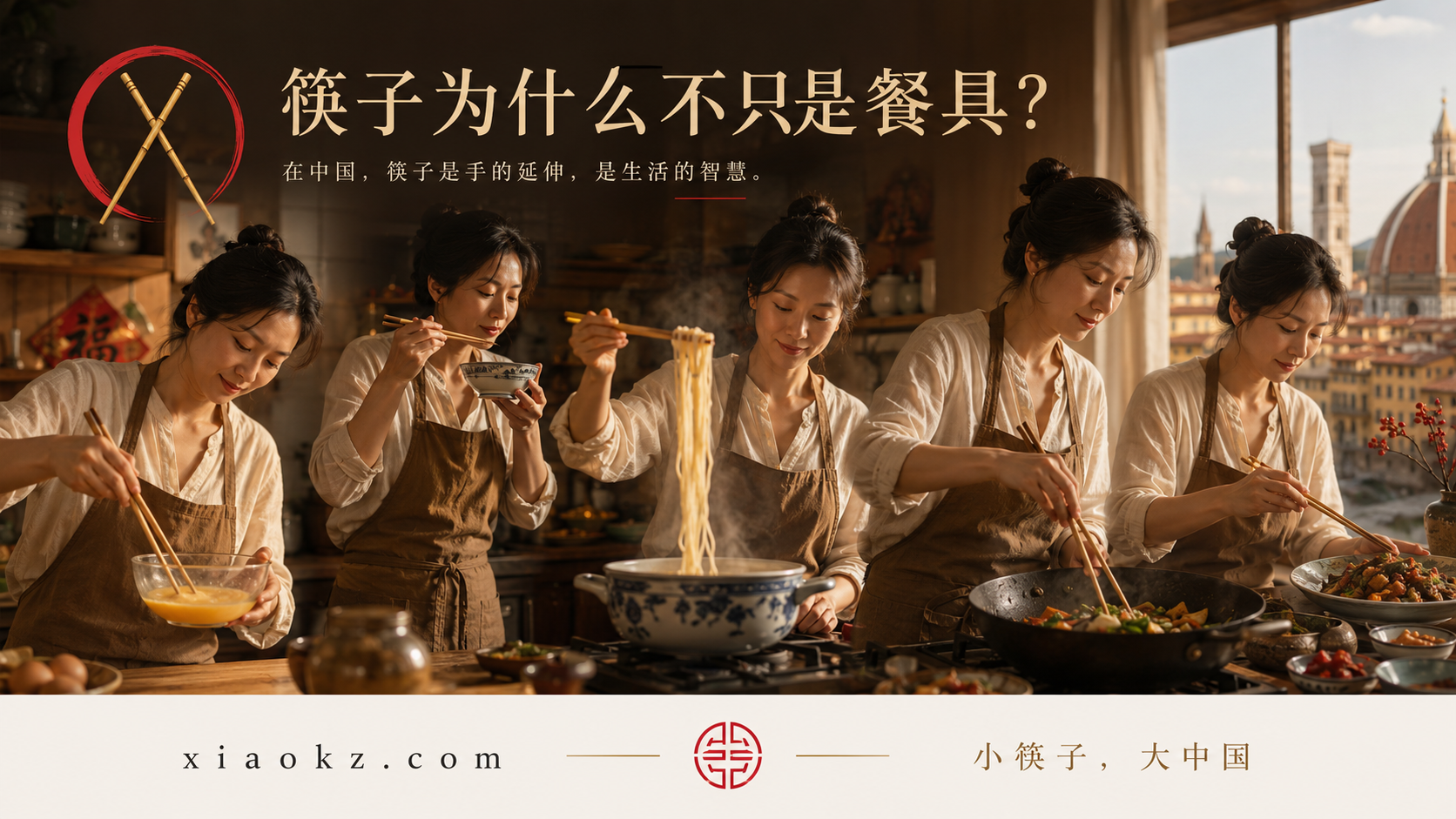
You're sitting at a Chinese friend's home, watching her in the kitchen as she prepares a meal. You see her use chopsticks to: whisk a bowl of eggs with rapid, clicking precision; taste the saltiness of a simmering soup without using a spoon; lift a tangle of noodles from a boiling pot without burning her fingers; stir-fry vegetables in a wok, flipping them with a wrist motion that seems almost magical; test the doneness of a dumpling by gently pressing its skin; separate a piece of fish from its bones with surgical delicacy; and finally, transfer food from a communal plate to individual bowls with the grace of a croupier dealing cards.
You ask, amazed: "You use chopsticks for everything?"
She smiles, not understanding why this is surprising: "Of course. Chopsticks aren't just for eating. In a Chinese kitchen, they are your hands when your hands are too hot, too cold, too wet, or too clean to touch the food directly."
You look around her kitchen. There is a spatula, but it looks almost unused. There is a ladle, but it sits in the corner. The whisk is still in its packaging. Everything, it seems, is done with two wooden sticks.
2. A Funny Misunderstanding
Many foreigners assume chopsticks are "the Asian version of a fork" — a specialized dining utensil meant only for eating, and eating only certain types of food at that. But in a Chinese kitchen, chopsticks are practically a universal tool, and calling them merely "tableware" is like calling a Swiss Army knife a "bottle opener."
Some Europeans are confused when they see a Chinese cook using chopsticks to stir eggs, flip fish, or separate dumplings. "Why not use a whisk?" they ask. "Why not use a spatula? There are specific tools for all of these!" They see it as improvisation. Chinese people see it as completely normal.
An American friend once told me: "I watched a Chinese chef debone a fish with chopsticks. It was like watching a surgeon with chopsticks instead of scalpels."
Another European said: "If I tried to flip a pancake with chopsticks, it would end up on the ceiling. But my Chinese roommate does it every morning. She doesn't even own a spatula."
3. The Chinese Explanation
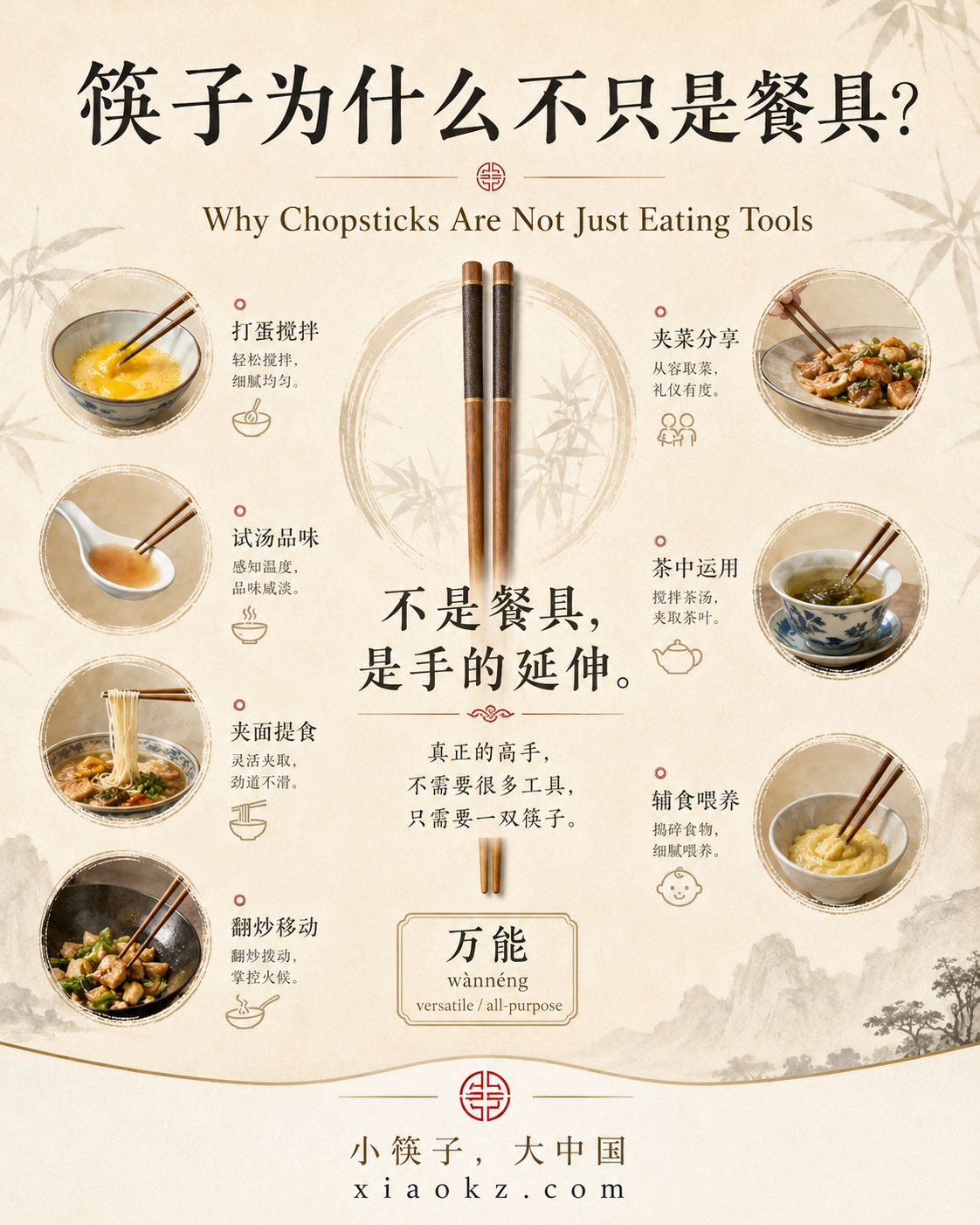
In Chinese daily life, chopsticks are indeed not just "tableware." They are a stirring tool, a cooking tool, a serving tool, a tasting tool, a testing tool, a tea utensil (for stirring teapots and retrieving tea leaves), a baby-feeding tool (mothers use small chopsticks to feed infants), and even — in ancient times — a writing instrument for marking bamboo strips before brushes were common.
Chopsticks are an extension of the Chinese hand. They are not merely "tools" but "part of the body" — an extension of the fingers that can reach into hot oil, boiling water, or delicate dishes without the rest of the hand being in danger. A skilled Chinese cook does not think, "What tool should I use for this task?" She thinks, "My chopsticks will handle this." And they do.
This is why Chinese kitchens can be surprisingly simple. A few knives, one cutting board, one wok, and several pairs of chopsticks — that is the complete toolkit of a master.
4. The Deeper Logic
This reflects the Chinese way of thinking: one thing, many uses. Western culture tends toward "one tool for one task" — a whisk for eggs, a spatula for flipping, a fork for eating, a knife for cutting. Chinese culture values the opposite: the more functions a single tool serves, the more it reflects the user's intelligence and mastery.
This is not about laziness or lack of tools. It is about the philosophical preference for simplicity and mastery over accumulation and specialization. A Chinese master chef does not need twenty kitchen gadgets, each with a specific purpose. He needs one pair of chopsticks and twenty years of practice. The tool does not make the master. The master makes the tool do anything.
The underlying message is profound: true skill is not having more tools. It is doing more with fewer tools. In a world that constantly sells us new gadgets, the Chinese kitchen says: learn one thing deeply, and you will need nothing else.
This philosophy extends beyond the kitchen. In Chinese culture, the ideal person adapts one fundamental skill to many situations. Chopsticks embody this principle daily.
5. Learn a Chinese Word
万能 (wànnéng)
- 万 (wàn): ten thousand, meaning "countless" or "all"
- 能 (néng): ability, capable
- Wànnéng literally means "capable of ten thousand things" — universal, all-purpose, all-capable.
- In Chinese, calling a pair of chopsticks "wànnéng" is the highest compliment in the kitchen. It means this tool is so versatile that it replaces all others. A wànnéng tool is not a jack of all trades and master of none — it is a master that can do everything.
- Remember: wàn is fourth tone (falling), néng is second tone (rising).
6. One-Sentence Summary
> To Westerners, chopsticks are tableware. To Chinese people, chopsticks are an extension of the hand. The true master doesn't need many tools — just one pair of chopsticks and a lifetime of practice.