1. A Scene: "Five Elements Soup" on the Menu
November 2024. Autumn in Florence was drawing to a close, and the morning and evening chill seeped into every alley like a thin layer of water. In the Giaogiao kitchen, a pot of fingers-of Buddha soup simmered gently on low heat. That faint coconut-and-herb aroma slipped through the door crack, making passers-by sniff the air.
Hans pushed the door open just as I was setting the soup pot on the table. He is German, forty-seven, working in quality control at a pharmaceutical company in the Florentine suburbs — the kind of person who deals with the periodic table every day. He comes to Giaogiao every Wednesday without fail, sits by the window, orders the poached beef, and drinks a cup of hot tea.
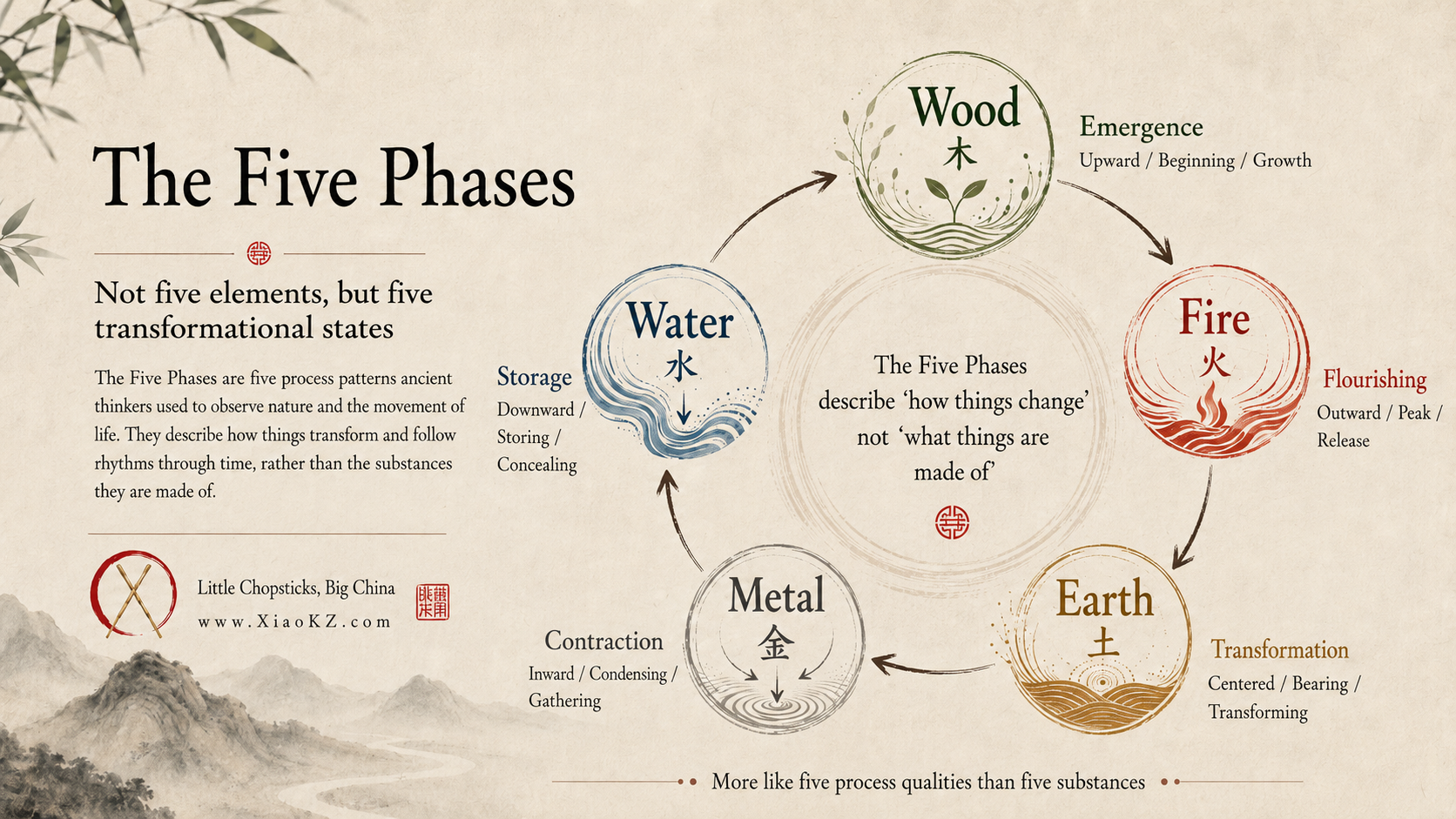
But today he didn't sit down right away. He stood by the wall, staring at the calligraphy scroll I had hung up last year — five characters: 木 (Wood), 火 (Fire), 土 (Earth), 金 (Metal), 水 (Water), arranged in a circle with arrows connecting them.
"Liu," he said, pointing at the scroll with a frown like he was inspecting a batch of unqualified raw materials. "What's this? Your Chinese periodic table?"
"What?"
"Metal, Wood, Water, Fire, Earth — five elements, right? I read about them in a book on Chinese philosophy. Ancient Chinese believed the world was made of these five things."
I put down the soup pot and wiped my hands.
"Hans, what is your daily rice bowl made of?"
"Ceramic."
"What's in ceramic?"
"Silicates… plus some metal oxides."
"By your logic, ancient Chinese would look at ceramic and say 'this is Earth.' But look at a knife and say 'this is Metal.' Look at a glass of water and say 'this is Water.' Correct?"
"Yes, that makes sense."
"Then let me ask you: a tree sprouts in spring, flourishes in summer, sheds leaves in autumn, and rests in winter — would ancient Chinese say this tree is Wood, or would they say it is going through a process?"
Hans paused.
"You mean…"
"I mean," I said, pulling him down to sit and pouring him a cup of tea, "Wu Xing is not five things. Wu Xing is five ways of changing."
---
2. A Light Misunderstanding: Ancient China's "Periodic Table"?
Hans held his teacup, his expression somewhere between confused and amused.
"So I've been reading the wrong thing for twenty years?"
"Not reading the wrong thing — led astray by the translation," I said. "In English, 五行 is translated as 'Five Elements.' Europeans see the word 'element' and instinctively think of Mendeleev, think of hydrogen, helium, lithium, beryllium, boron."
"Isn't that what it means?" Hans asked. "If Wu Xing isn't elements, then how did ancient Chinese explain what the world is made of?"
"They never cared what the world was 'made of' at all," I said.
Hans's eyes widened. For someone who lives with molecular formulas every day, this was like saying "the Earth is flat."
"Hans, have you ever noticed," I said, "that the ancient Greeks asked: what things is the world made of? Thales said water. Heraclitus said fire. Democritus said atoms. They were looking for 'the smallest unit that makes up the world.'"
"Yes, that's the foundation of Western science."
"But ancient Chinese asked a completely different question. They didn't ask 'what is the world?' They asked 'how is the world changing?'"
"How is it changing?"
"In spring, seeds sprout — this is Wood. In summer, the sun blazes — this is Fire. In late summer, fruits ripen and return to the earth — this is Earth. In autumn, the harvest: metal sickles cut the wheat — this is Metal. In winter, all things hide away; water freezes — this is Water. And then spring comes again."
"So Wu Xing is not five substances," Hans said slowly. "It's… five seasons?"
"Not exactly. But your idea is already closer than 'five elements.' Wu Xing is five phases, like cutting a process into five slices. Each slice has its own character, but none of them is still."
Hans thought for a moment, then suddenly laughed.
"So that book of mine calling it 'ancient China's periodic table' is like describing a symphony as 'five notes'?"
"Very much so." I laughed too. "And what's worse is that these five 'notes' are treated as static things. Wood means timber, Fire means flame, Earth means mud — completely forgetting that they are part of a piece of music."
---
3. The Chinese Explanation: What Is Wu Xing Really Saying?
"Let me make this clear for you," I said, "but first I need you to do something — completely delete that 'periodic table' from your mind."
"Deleted," Hans said, though his expression told me this was harder for him than deleting a non-compliant batch.
"Good. Now, imagine a seed."
"Okay."
"In spring, it sprouts. That upward-pushing force — breaking through the soil, growing toward the sun — Chinese call this Wood. Wood is not timber. Wood is the power of generating, of beginning, of rising, of expanding."
"Like starting up a machine?"
"Yes, but more than that. Wood is vitality. When you wake up in the morning feeling 'I've got energy today,' that's the Wood in your body at work."
"Go on."
"In summer, that tree grows most vigorously. The sunlight is strongest, the temperature highest; all things are 'burning' their life force. This force of 'hottest, most exuberant' — Chinese call this Fire. Fire is not flame. Fire is flourishing, the peak, outward release."
"Then what?"
"Late summer — the transition from summer to autumn — fruits ripen, fall from the tree, and return to the earth. This is the moment of transformation. The climax of growth has passed; energy begins to 'gather,' to 'transform.' This force of 'transformation, bearing' — Chinese call this Earth. Earth is not dirt. Earth is the center, the process of transformation, the medium that turns one thing into another."
"Like a reaction vessel?"
"Ha, your occupational disease is showing. But yes — Earth is that 'container' where change happens inside."
"And autumn?"
"In autumn, leaves fall and fruits are gathered. All things begin to 'gather in,' turning from outward to inward. Metal is sharpest in autumn — the harvest sickle, the felling axe. This force of 'contraction, austerity, concentration' — Chinese call this Metal. Metal is not gold. Metal is gathering in, the force that ends a cycle."
"Winter?"
"In winter, all things lie hidden. Water freezes, the earth freezes, seeds sleep in the soil. This force of 'concealment, downward movement, nourishment' — Chinese call this Water. Water is not H₂O. Water is storing, the preparation waiting for the next generating to begin."
Hans was silent for a long time.
"So," he finally said, "Wood, Fire, Earth, Metal, Water are not five substances. They are five… energy states?"
"Closer. They are five process characteristics. Each describes a 'how it moves,' not a 'what it is.'"
"And they are in a cycle?"
"Yes. That is the very core of Wu Xing — mutual generation (相生)."
I drew a circle on paper.
"Wood generates Fire — wood burns to produce fire. Fire generates Earth — after burning, fire becomes ash, returning to earth. Earth generates Metal — metal is dug from the earth. Metal generates Water — metal heated melts into liquid. Water generates Wood — water nourishes trees to grow."
"This is a cycle of creation."
"Yes. But there is another cycle — mutual restriction (相克)."
I drew a pentagram.
"Wood restricts Earth — tree roots pierce through soil. Earth restricts Water — earth blocks water. Water restricts Fire — water extinguishes fire. Fire restricts Metal — fire melts metal. Metal restricts Wood — the axe cuts the tree."
"This is a cycle of control."
"Yes. Mutual generation is 'nourishment.' Mutual restriction is 'restraint.' Both cycles run simultaneously, like a machine that has both accelerator and brake."
Hans looked at the two diagrams as if he were looking at a complex process flowchart.
"So," he said, "when Traditional Chinese Medicine says 'your Liver Fire is excessive,' it doesn't mean there is actual fire in my liver?"
"Of course not. 'Liver Fire excessive' means: some system in your body is in the Fire state — too exuberant, too dry, too outward. It needs Water to balance, or Metal to gather in."
"My God," Hans said, "this is completely different from my training. What I learned is: find the problematic thing, replace it. What you are saying is: find the problematic state, adjust its relationship."
"Now you understand."
---
4. The Cultural Logic Behind It: Why Do Chinese People Look at "Process," Not "Things"?
"Hans," I said, "let me tell you a story of my own."
"In 2002, I had just moved from Germany to Italy. I was in my early thirties, my head full of 'doing something big.' I started a trading company, importing goods from China to Europe. My logic was simple: find good products, buy low, sell high."
"Typical business thinking."
"Yes. But the problem was my body couldn't keep up. I started having insomnia, stomach pain, hair loss. I went to a German doctor — I had lived in Germany for seven years and trusted their medicine."
"What did the doctor say?"
"Endoscopy, blood tests, ultrasound — the full package. The result: chronic gastritis, Helicobacter pylori positive. He prescribed antibiotics and acid suppressants."
"Did it get better?"
"The bacteria were killed, the stomach pain stopped. But three months later, it flared up again. More medicine, better again, flared up again."
"A cycle."
"Yes, a cycle. Later I went to London and saw a TCM doctor from Hong Kong. He didn't do any tests on me — no endoscopy, no blood work — he took my pulse, looked at my tongue, and asked me a whole lot of questions: what time do you sleep? What do you eat? How are your emotions? What are your bowel movements like?"
"And then?"
"He said: 'Your Spleen-Earth is too weak, your Liver-Wood is too strong. Wood is restricting Earth; your liver is bullying your stomach.'"
Hans laughed: "Your liver is bullying your stomach?"
"I know it sounds strange. But he continued: 'You don't have a stomach disease. It's your life rhythm making Wood too strong — you are too rushed, too tense, too eager to succeed — and Earth can't keep up. Earth is transformation, digestion. Your Earth is too tired, so Wood comes to restrict it.'"
"What advice did he give you?"
"He didn't give me medicine. He wrote me a 'life prescription': walk forty minutes every day. Don't eat dinner too late. No phone before bed. At least one day a week, do nothing at all."
"That's it?"
"That's it. Three months later, my stomach never hurt again."
Hans was silent.
"The key isn't that it got better," I said. "The key is that the two doctors were speaking completely different languages."
"The German doctor said: you have bacteria, I kill the bacteria. He was talking about things — bacteria are the enemy, medicine is the weapon."
"The TCM doctor said: your Wood and Earth relationship is out of balance. He was talking about relationships — not that something is broken, but that some rhythm is off."
"This is a lot like Yin and Yang," Hans said. "Western medicine looks for the enemy; Chinese medicine looks for balance."
"Yes. But Wu Xing is more concrete than Yin-Yang. Yin-Yang are two poles; Wu Xing are five 'tonal colors.'"
"On a deeper level," I said, "this reflects a difference in cultural thinking."
"Europeans — or rather, Indo-European language speakers — have a deeply ingrained habit: dividing the world into things. Subject and object. Me and the world. Observer and observed."
"The ancient Greeks invented the 'atom' — the indivisible smallest particle. Then all of Western science kept searching for smaller particles. From atom to electron, to quark, to string."
"Chinese never thought this way."
"The closest thing ancient China had to 'atomism' was probably Qi (气). But Qi is not a particle — Qi is flowing, continuous."
"When Chinese look at a tree, they don't ask 'what atoms is this tree made of.' Chinese ask: what phase is this tree in now? Is it spring generating (Wood), or summer flourishing (Fire), or autumn gathering (Metal), or winter concealing (Water)?"
"So," Hans said slowly, "Wu Xing is not a cosmology. It is a… grammar for describing change?"
"Exactly." I said. "Just as you use verbs to describe actions, Chinese use Wu Xing to describe 'ways of changing.'"
"Wood is the grammar of 'beginning.' Fire is the grammar of 'flourishing.' Earth is the grammar of 'transformation.' Metal is the grammar of 'gathering in.' Water is the grammar of 'concealment.'"
"And a machine, a country, a body, a relationship — anything can be described using these five grammars."
"This is the power of Wu Xing: it doesn't tell you what the world is; it teaches you a way of seeing the world."
---
5. Learn a Chinese Word: Why Is It Called "Xing" (行)?
"Speaking of ways of seeing," I said, "let's learn a Chinese word today."
I wrote a character on paper: 行.
"Hans, do you know this character?"
"Xíng? Meaning 'to walk'?"
"Yes. The most common meaning of 行 is 'to walk' — walking, strolling. But within this character lies the biggest secret of Wu Xing."
"What secret?"
"Look at the oracle bone script of 行 —" I drew a crossroads on paper, "it depicts a crossroads, four roads meeting."
"So the original meaning of 行 is not 'walk,' but 'road'?"
"It is 'road,' and also 'being on the road.' Later it extended to 'walk,' then to 'move,' 'proceed,' 'circulate.'"
"Now the key question is: why is it called 五行 (Wu Xing) and not 五物 (Five Things), 五素 (Five Elements), 五材 (Five Materials)?"
"Because from the very beginning, Chinese never treated them as 'things.'"
"The character 行 emphasizes movement, process, being on the road."
"So the true meaning of 五行 is not 'five elements,' but 'five ways of moving' — five states of 'being on the road.'"
Hans looked at that character as if seeing it for the first time.
"Are there other examples of this in Chinese?"
"Plenty."
"Chinese say '天行健' (Tiān xíng jiàn) — the movement of Heaven is vigorous and unceasing. They don't say 'Heaven is a certain thing,' they say 'Heaven is xing (moving).'"
"Chinese say '道行' (dào héng) — a person's 'accomplishment' in virtue, a kind of 'walking' skill."
"Chinese say '行情' (háng qíng) — the market's 'trend.'"
"Chinese say '德行' (dé xíng) — virtue is not a static quality; it is 'walked' out."
"So," Hans said, "the character 行 itself contains the meaning of 'change' and 'process'?"
"Yes. That is why 五行 cannot be translated as 'Five Elements.' In English, 'element' is static — hydrogen is hydrogen, oxygen is oxygen; they don't turn into something else. But in Chinese, 行 is dynamic — Wood can become Fire, Fire can become Earth, Earth can become Metal."
"Translate it wrong, and the whole concept dies."
"It dies," I said. "Translating 五行 as 'Five Elements' is like translating a symphony into 'five notes' — the notes are correct, but the music is gone."
---
6. One-Sentence Summary: What Took Me 25 Years to Understand
Outside, it was completely dark. The guests at Giaogiao had gradually dispersed; the last batch of dishes in the kitchen had been washed. Hans's teacup was empty, but he showed no sign of leaving.
"Liu," he said, "I've been in quality control at a pharmaceutical company for twenty years. My job is to make sure the ingredients in every pill match exactly what's written on the label."
"One hundred milligrams means one hundred milligrams. One milligram too much,不合格 (unqualified). One milligram too little, also unqualified."
"My world is precise, static, quantifiable."
"But what you said today made me realize: I have always thought 'precision' is the only correct way."
"Yet life is not a pill. Life is change."
"I cannot weigh 'my anxiety.' I cannot run a lab test on 'my exhaustion.' I cannot do an HPLC analysis on 'my loneliness.'"
"But these 'unquantifiable' things are real."
I smiled.
"Hans, you don't need to give up your HPLC. What you need is to grow a second pair of eyes, beyond the HPLC."
"A pair of eyes that sees process."
"Wu Xing is that pair of eyes."
He stood up and put on his coat. At the door, he suddenly turned around.
"Liu, next time I come, could you make me a 'Wu Xing menu'?"
"What?"
"In spring, eat Wood — generating things. In summer, eat Fire — exuberant things. In autumn, eat Metal — gathering things. In winter, eat Water — concealing things."
"With Earth in between — transforming everything."
I burst out laughing.
"Hans, you've already learned it. Wu Xing is not a subject; it's a way of living."
He pushed the door open and walked into the Florentine night. The wind chime rang once, as if drawing a full stop to our conversation.
> Wu Xing is not five substances. It is five ways of changing.
>
> It took me 25 years to understand: when I was obsessed with asking "what is this?" I missed the more important question — "how is this changing?" And the Chinese knew three thousand years ago: the world is not made of "things." The world is a never-ceasing flow.
---
Have you ever had that feeling where "nothing has changed, yet everything has changed"? Or found yourself stuck in a certain "phase" and unable to get out? Tell me your story — the next xiaokz article might just be written for you.