1. A Scene: An Italian with a Cold
Winter 2022. Florence saw its heaviest snowfall in a century. Giaogiao's heating was on full blast, yet ice flowers still formed on the windows.
That evening, a regular customer—Andrea, 38, a local architect from Florence—walked in. His nose was red as a tomato, his scarf wrapped in three layers, his gait like a bamboo bent under weight.
"Give me a bowl of beef noodles," he said, his voice emerging from somewhere underground, "and extra chili."
"You have a cold," I said. "Chili won't cure a cold."
"Then what will?"
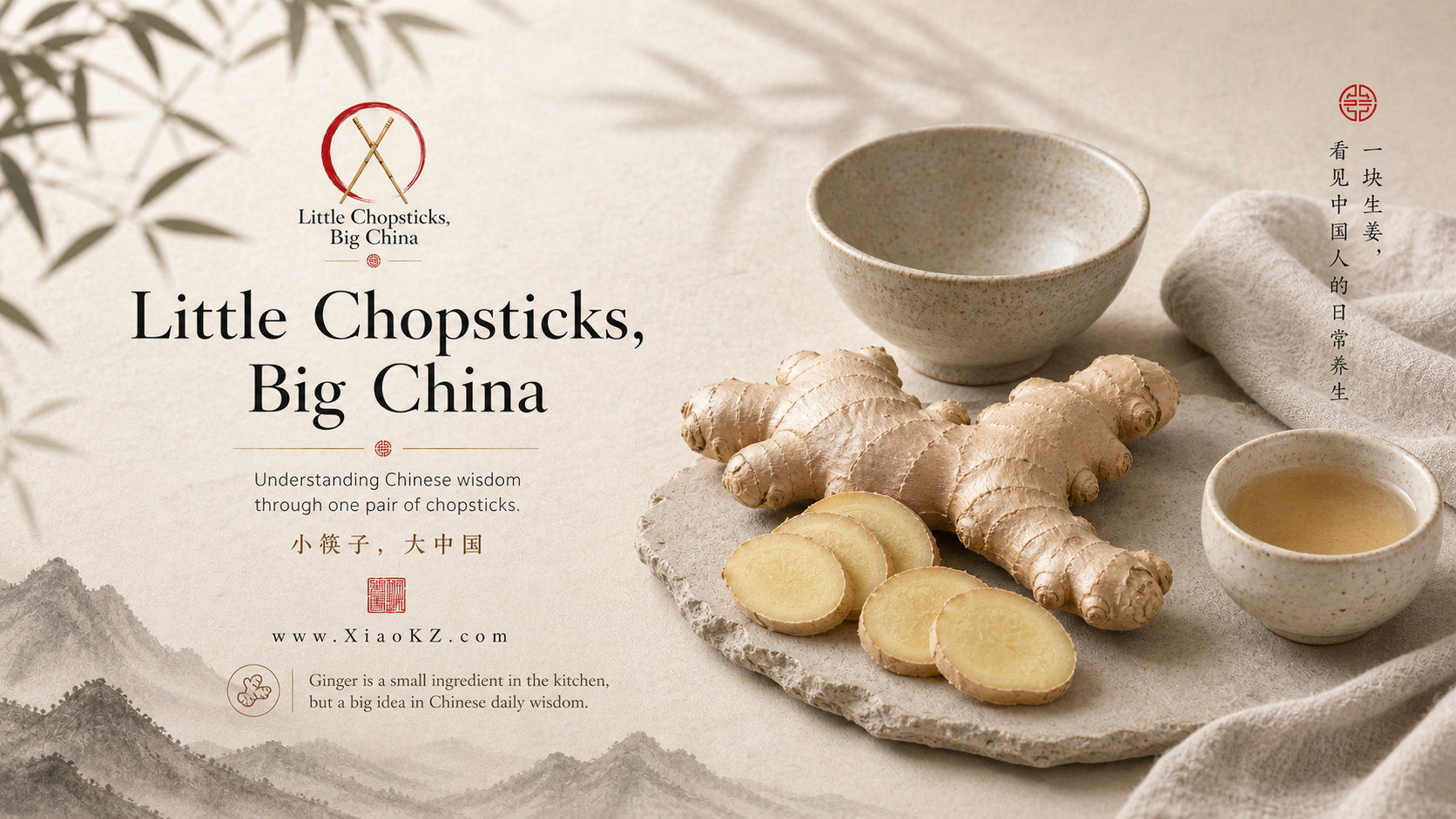
I didn't answer. I turned and walked into the kitchen, pulling out a small bottle from the counter. Dark brown liquid in a clear glass bottle, with two characters written in marker on the label: ginger soup.
"Drink this." I handed him a small cup.
Andrea sniffed it and frowned. "What is this? Witch's potion?"
"This is what Chinese people drink when they have a cold. It's called ginger soup."
"Ginger?" Andrea looked puzzled. "You mean that little yellow root? The one we put in stir-fries?"
"Yes, that one. But in China, ginger is not just a seasoning. Ginger is medicine."
Andrea took a skeptical sip. His expression shifted from caution to surprise.
"So spicy," he said, "but... my stomach feels warm."
"That's right," I said. "You're not drinking a flavor. You're drinking a direction."
"A direction?"
"Yes. Ginger pushes your body from 'cold' toward 'warm.'"
---
2. A Funny Misunderstanding: Is Ginger Just a Seasoning?
Andrea finished the ginger soup and placed the cup on the table. His nose seemed less red.
"I have to ask," he said, "why do you Chinese treat ginger as medicine? In Europe, ginger is just a curry ingredient."
"Because in Europe, 'medicine' and 'food' are separated."
"What do you mean?"
"Look," I said, "when you get sick in Europe, you go to the pharmacy for medicine. Medicine is white, has instructions, has chemical ingredients. Food is brown, sits in the kitchen, exists to satisfy your taste buds."
"But in China, there is no wall between medicine and food."
"Chinese people say '药食同源'—medicine and food come from the same source."
"Ginger is the most typical example."
"In Chinese medicine, ginger is not a 'seasoning.' Ginger is a medicine that 'warms the center and dispels cold.' Its function is: to warm your stomach and drive out the cold energy inside your body."
"So when you catch a cold and there is cold energy in your body—not bacteria, but cold energy—Chinese people don't say 'go to the pharmacy for antibiotics.' They say 'go to the kitchen and cook ginger soup.'"
Andrea was stunned.
"You're saying Chinese people turn the kitchen into a pharmacy?"
"Not exactly," I said. "Chinese people tore down the wall between the kitchen and the pharmacy."
---
3. The Chinese Explanation: The "Medicinal Nature" of Ginger
"Let me tell you a historical story," I said.
"200 BCE, Han Dynasty. There was a doctor named Zhang Zhongjing. He wrote a book called Shang Han Lun—one of the most important classics of Chinese medicine."
"In this book, Zhang Zhongjing used ginger more than 100 times. Why did he use ginger?"
"Because ginger has three major functions:"
"First, ginger can 'disperse.' When you catch a cold, cold energy is 'trapped' on the surface of your body. Ginger can 'push' the cold energy out—making you sweat, allowing the cold to leave with the sweat."
"Second, ginger can 'warm the center.' Your stomach is like a pot. It needs fire to cook food. Ginger is what adds 'fire' to the stomach. When the stomach is warm, digestion improves."
"Third, ginger can 'stop vomiting.' That's why Chinese people give ginger to pregnant women when they feel nauseous."
Andrea listened attentively.
"But in Chinese medicine, ginger doesn't work for everyone."
"What do you mean?"
"Chinese medicine talks about 'constitution.' If you are a 'hot constitution'—prone to getting inflamed, red-faced, dry-mouthed—then eating ginger is like pouring oil on an already blazing fire."
"But if you are a 'cold constitution'—always cold, cold hands and feet, prone to diarrhea—then ginger is your best friend."
"So ginger is not a universal medicine. Ginger is most useful for people with 'cold' constitutions."
Andrea thought about it: "What about me? Am I hot or cold?"
"You're wearing three scarves and you have a cold," I laughed. "You're cold."
---
4. The Deeper Logic: Why Chinese People Value the Kitchen
"Andrea," I said, "have you ever wondered why Chinese cuisine has so many 'food-as-medicine' ingredients?"
"For example, goji berries—you put them in salads as decoration. Chinese people put them in soup as a tonic."
"For example, red dates—you use them to make cakes. Chinese people use them to nourish blood and Qi."
"For example, Chinese yam—you fry it as a vegetable. Chinese people use it to strengthen the spleen."
"Because in Chinese culture, 'eating' is not just about staying alive. 'Eating' is about 'living well.'"
"In 1998, when I first arrived in Germany, I went to a German supermarket for the first time. I saw rows and rows of vitamin bottles, mineral supplements, protein powder. I was shocked."
"Because in Chinese supermarkets, you don't see these things. Chinese people's 'health supplements' are not in the supplement aisle. They are in the vegetable aisle, the dried goods aisle, the seasoning aisle."
"Ginger, garlic, scallions, vinegar, goji berries, red dates, longan—these are Chinese people's 'vitamins.'"
"Westerners break nutrition down into molecules: vitamin C, calcium, iron, protein."
"Chinese people keep nutrition as a whole: ginger is warm, pear is cool, red dates are sweet—every food has a 'nature' and a 'flavor,' corresponding to different needs of the body."
"So ginger is not a seasoning," I said. "Ginger is the Chinese people's response to the body's needs."
---
5. Learn a Chinese Word: Why Is It Called "姜"?
"Speaking of ginger," I said, "let's learn a Chinese word today."
I wrote a character on the paper: 姜.
"Look at this character. The top part is 'sheep,' the bottom part is 'woman.'"
"Why?"
"Because ginger was originally used as a 'sacred plant.' In ancient times, ginger was used in rituals because its spiciness was believed to 'dispel evil'—drive away bad things."
"Later, ginger entered the kitchen. But even in the kitchen, Chinese people never forgot its 'medicinal nature.'"
"Chinese people say: 'Eat radish in winter and ginger in summer, and the doctor won't need to write a prescription.'"
"Eat radish in winter—radish is cool. In winter, the body has internal heat. Eating radish brings balance."
"Eat ginger in summer—ginger is hot. In summer, the body is hot outside but cold inside. Eating ginger warms the interior."
"Andrea, have you noticed: when you stay in an air-conditioned room too long in summer, does your stomach feel uncomfortable?"
"Yes!" Andrea said. "I thought it was just my weak stomach."
"It's not your weak stomach. It's your stomach being 'cold.' The air conditioner's cold air has robbed your stomach of its temperature. At this moment, eating a slice of ginger, or drinking a bowl of ginger soup, is the best 'medicine.'"
---
6. One-Sentence Summary: What I Took 25 Years to Understand
Andrea's beef noodles arrived. He took a sip of the soup and looked at me.
"Liu," he said, "I'm going to the supermarket tomorrow to buy ginger."
"Why?"
"Because I want to try it. Not as medicine—but as a 'direction.'"
"When I feel cold, I won't just add clothes. I'll try adding a 'fire' to my body."
I smiled.
"You've already started thinking like a Chinese person."
"The Western way of thinking is: I'm cold, so I turn up the heater."
"The Chinese way of thinking is: I'm cold, so I let my body generate its own heat."
"Ginger is the key that lets the body generate its own heat."
> Ginger is not a seasoning. It is "the first key in the Chinese medicine cabinet" placed in the kitchen.
>
> It took me 25 years to understand: when I slice a piece of ginger and put it in the pot, I am not cooking a dish. I am writing a prescription for my body—with temperature and direction, not chemical ingredients.
---
Have you ever tried ginger soup when you had a cold? Or do you think ginger is just a seasoning? Tell me your thoughts—the next xiaokz article might just be written for you.