One. A Winter Day in Florence, I Serve Marco a Pot of Stew
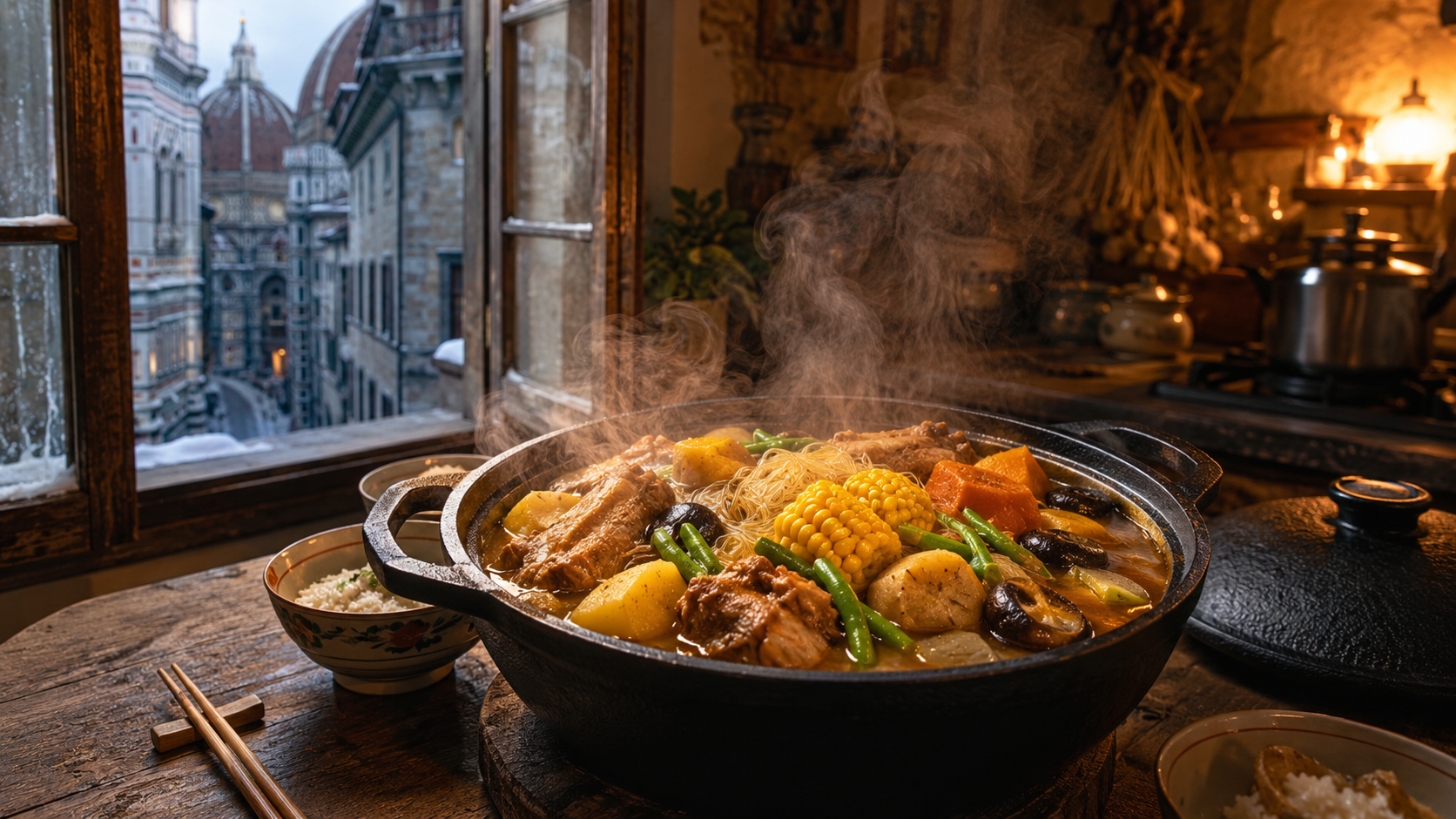
Marco stares at the iron pot on the table — larger than my face — and freezes.
"Coach," he says, "how many things are in there?"
I count: potatoes, green beans, eggplant, pumpkin, pork ribs, corn, glass noodles, shiitake mushrooms, and a handful of perilla leaves I picked from the balcony before leaving.
"About nine."
"Nine?" His eyes widen. "Nine things in one pot? Are you cleaning out the fridge?"
I laugh. Twenty years ago, freshly arrived in Germany, I showed a classmate a photo of my mother's Dongbei stew for the first time. His reaction was identical: "Is this your family's garbage bin?"
"No," I say. "This is Northeastern philosophy."
"What philosophy?"
"Everything goes in, and in the end, it all becomes family."
Two. My Mother's Stew, and What I Learned in 25 Years in Europe
My name is Liu Jiayong, from Heilongjiang. "White mountains, black waters" is not a poetic phrase — it is what I saw every morning when I opened my eyes: white is the snow of Changbai Mountain, black is the water of the Songhua River. I grew up eating my mother's stew. In twenty-five years in Europe, I have learned many dishes, but there is one dish I will never learn to make: my mother's stew.
Not the recipe. I learned that long ago. Blanch the ribs, trim the green beans, cut potatoes into rolling wedges, tear eggplant by hand, soak glass noodles in warm water. I know all that.
But I can never replicate the taste.
Because that taste is not made by seasoning — it is stewed by time. It is the taste of my mother rising at six in the morning, lighting the stove, layering the vegetables one by one, then sitting on the kang to sew shoe soles, lifting the lid now and then, poking a potato with chopsticks to see if it has softened — that taste.
Europe has stews too. French cassoulet, Burgundy beef stew, Italian stracotto. I run a restaurant in Florence; I have made them all. European stews are precise: when to add wine, when to add potatoes, the exact temperature for the meat. They care about control.
Dongbei stew does not care about control. Dongbei stew cares about: whatever you have, put it in, and in the end it is all one pot.
This is not because Northeasterners "don't care." On the contrary, it is because Northeasterners know too well what it means to "not be able to afford to care."
Three. The Northeastern Winter Dictates How Northeasterners Eat
The first time I took an Italian to the Northeast, it was 2005. I took him to my hometown. After walking around Harbin's Central Street, he asked me a question:
"What do people here eat in winter?"
I said: "Outside it's minus thirty degrees. There is nothing in the ground. You think they have a choice?"
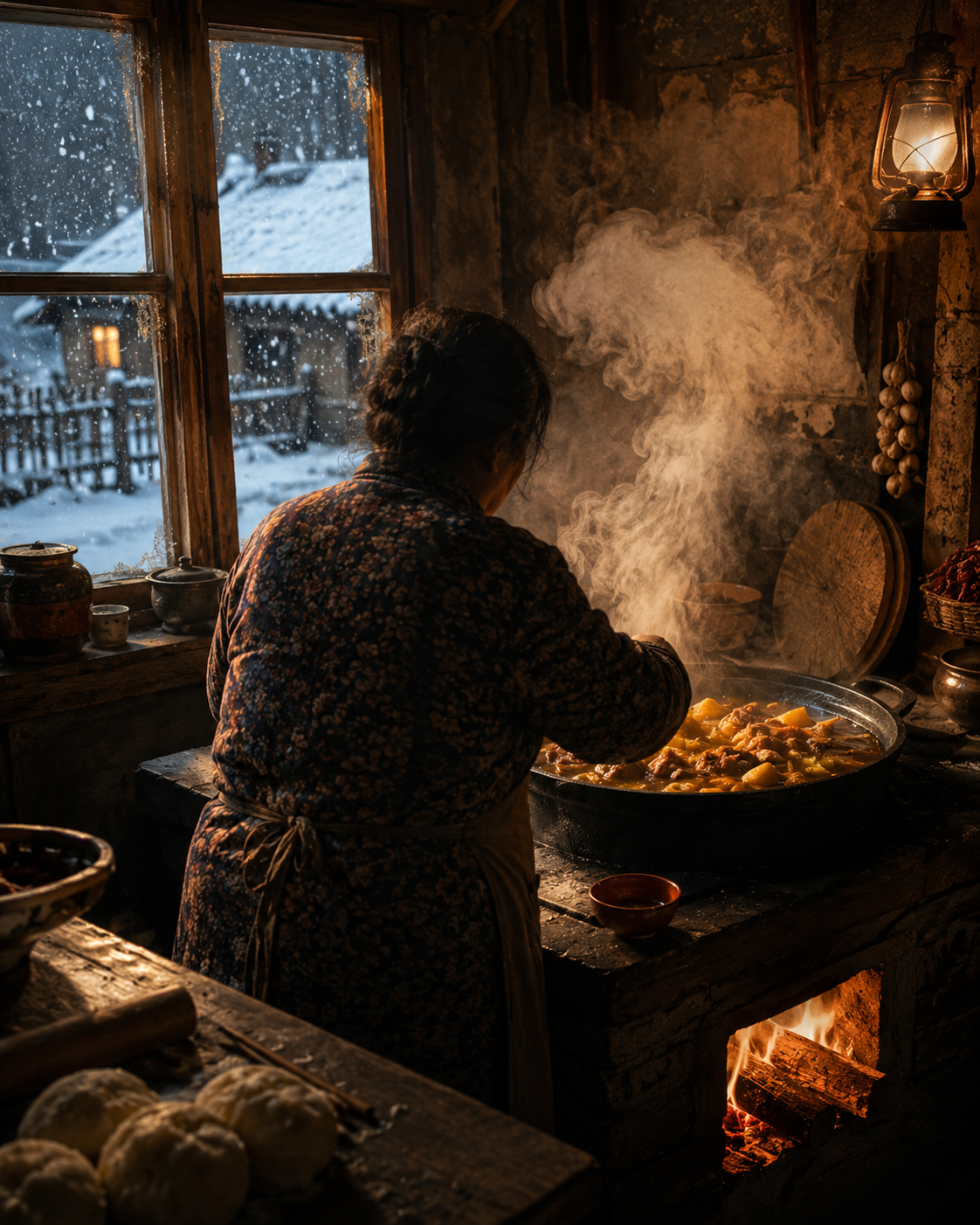
The Northeastern winter lasts from November to March — a full five months. During these five months, the outdoors is a natural freezer, and also a natural death zone. No fresh vegetables, no fruit, transportation is difficult. Northeasterners must prepare their winter food in autumn: cabbage pickled into sauerkraut, radishes dried in the sun, green beans sliced and air-dried, potatoes and cabbage stored in the cellar.
Then winter comes. The whole family sits around the kang, a large iron pot on the stove, and everything stored from summer and autumn — sauerkraut, dried beans, potatoes, glass noodles, tofu, leftover meat from New Year — all goes into one pot, with water, oil, salt, and stewed.
"Chaotic stew" is not chaotic. "Chaotic stew" is the Northeastern answer to winter: we have no choice, but we can turn what we have no choice about into the best choice.
Four. The Temper of Northeasterners Is Hidden in a Pot of Stew
Northeasterners have one characteristic: generosity.
Northeastern generosity is different from Shanghai refinement. Shanghai refinement is about details, about measure, about "this can't go in, that can't be too much." Northeastern generosity is: "You are a guest, so everything in the pot is yours."
I run a restaurant in Florence. Sometimes when guests order, I politely say, "Feel free to add more." Northeastern guests will say: "Coach, you're too polite. Back home, dishes are served on huge plates — who asks guests to add more?"
Dongbei stew is the philosophy of the big plate. The bigger the pot, the bigger the heart. You cannot be petty — pettiness is shameful in the Northeast.
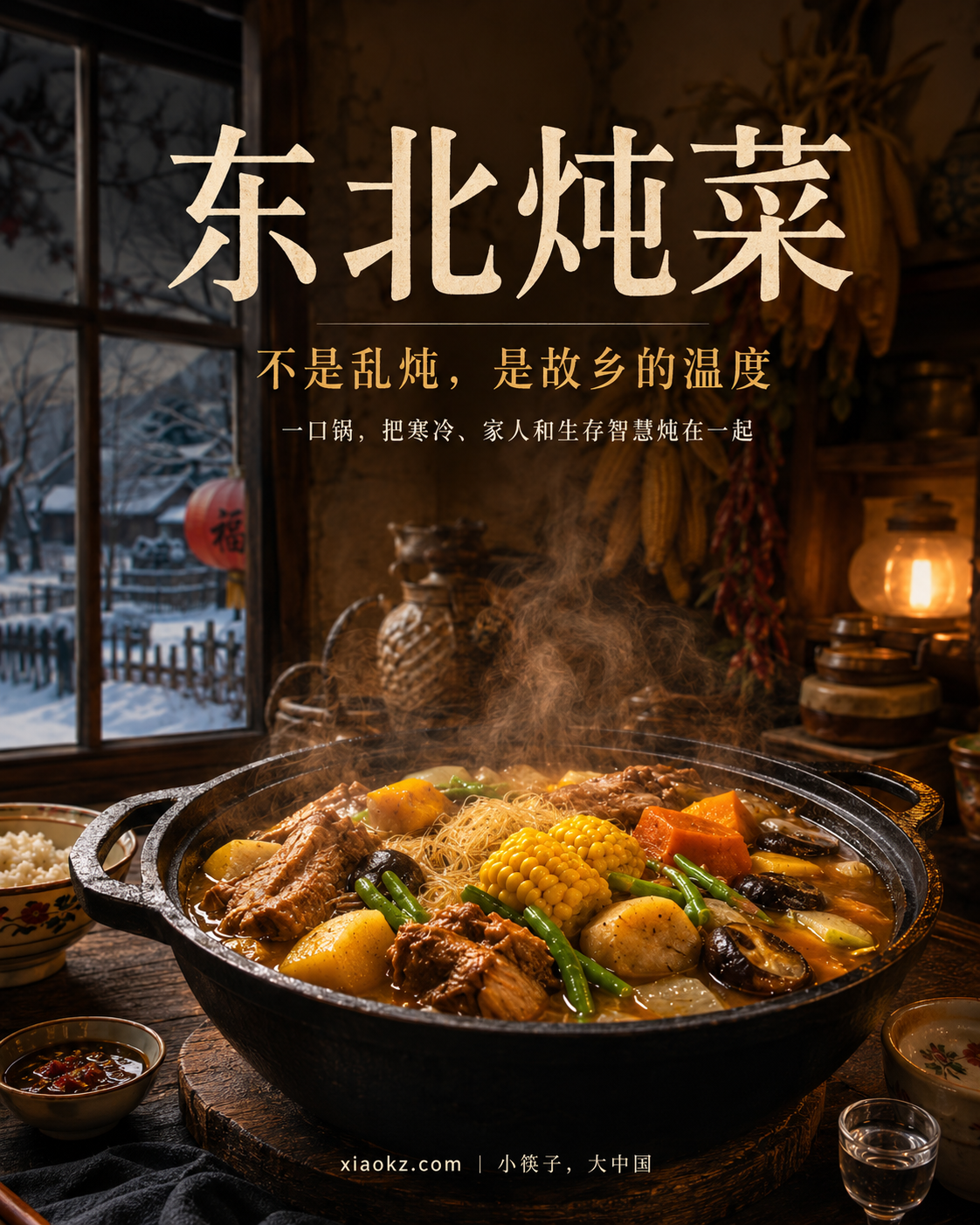
More importantly, Dongbei stew has an awareness of "equality." In Europe, a French dish has a main course, sides, and sauce — clear hierarchy, the chef's authority is supreme. In Dongbei stew, there is no main or supporting role. Pork ribs and potatoes, green beans and glass noodles are equal in the pot. No one needs to steal the spotlight; in the end, they all become one broth.
This is not compromise. This is wisdom.
Northeasterners know: on this land where winter lasts five months and temperatures drop to minus forty degrees, you cannot rely on anyone but yourself. But "yourself" is not one person — it is a family. As long as the family is together and there is something in the pot, there is nothing to fear.
Five. The Dongbei Stew I Make in Florence Will Never Be the Same
The Dongbei stew I make in Florence will never be the same as my mother's.
I use ribs from an Italian supermarket. The green beans are Italian fagiolini. The pumpkin is Japanese, not Northeastern wogua. I cannot even find real Northeastern sauerkraut, so I use German Sauerkraut from the supermarket instead.
The taste is right, but something is always missing.
Until one day, my neighbor in Florence — an eighty-year-old Italian lady — came to my house for dinner. She took a bite of my stew and said:
"There is a taste in this dish. It is not seasoning. It is memory."
She continued: "When I make stracotto, my husband — who passed away fifteen years ago — would wait for me in the kitchen every Christmas. Every time I make this dish, it feels like he is still waiting."
I suddenly understood.
What is missing from my Dongbei stew is not the sauerkraut, not the Northeastern potatoes. It is the stove fire at six in the morning on a winter day, my mother sitting on the kang sewing shoe soles, the laughter of our whole family gathered around the big iron pot, chopsticks searching for our favorite piece of potato.
That taste is called "home."
Six. When I Explain Dongbei Stew to Europeans, I Don't Give a Recipe — I Tell a Story of Survival
When Europeans ask me "how do you make Dongbei stew," I don't want to give them a recipe.
I want to tell them a story:
In the Northeast, there is a place called the "Great Northern Wilderness." Decades ago, there was no one there, only snow and wilderness. Then came a group of young people from all over China, to open up the land. They lived in underground shelters, winter temperatures of minus forty degrees, no heating, only a kang to sleep on. What did they eat? A pot of chaotic stew. Whatever they had, put it in, and in the end it was all one pot.
These people became the Northeasterners. They taught the next generation: winter is long, but don't be afraid. As long as the family is together, as long as there is something in the pot, you can survive.
This is not a dish. This is a philosophy of survival.
Europe has cold winters too. The snow in the Alps is no less than that of Changbai Mountain. But Europeans have fireplaces, heating, supermarkets. Northeasterners have none of that. Northeasterners have only a family, and a big iron pot.
So when you see a Northeastern Chinese throw nine ingredients into one pot, don't laugh at them for "not caring."
Respect them. Because they are telling you, in the most humble way: life is hard, but as long as there is something in the pot and the family is together, there is nothing to fear.
Postscript: My Stew in Florence Is Also My Dongbei Stew
Every time I make Dongbei stew in Florence, I am not really cooking pork ribs and green beans.
I am cooking the stove fire my mother lit at six in the morning at minus thirty degrees, the potatoes my father carried up from the cellar, the smell I caught while doing homework on the kang, and the only source of warmth our family had in winter — that big iron pot.
I have been in Europe for twenty-five years, cooking it in Florence for six. Every time I stew, I think: perhaps my mother's spirit can smell the taste from this pot.
That taste is not pork ribs, not green beans.
That taste is: no matter how far I go, no matter how many years in Europe, I am still the child of Heilongjiang. The home of white mountains and black waters will always be in my pot.
---
> Coach Liu Says
>
> Dongbei stew is not a recipe — it is a coordinate of home. Next time you go to Northeastern China, don't ask "where is the best stew." Go to an ordinary family's home and look at the big iron pot on their stove. The taste in that pot is the Northeast.
Related Reading
- [Peking Duck: From Palace to the People](https://www.xiaokz.com/content/en/dongbei-stew.html) → Next article
- [The Hidden Rules of the Chinese Dining Table](https://www.xiaokz.com/content/en/chinese-table-rules.html)
- [What Is Qi?](https://www.xiaokz.com/content/en/what-is-qi.html)